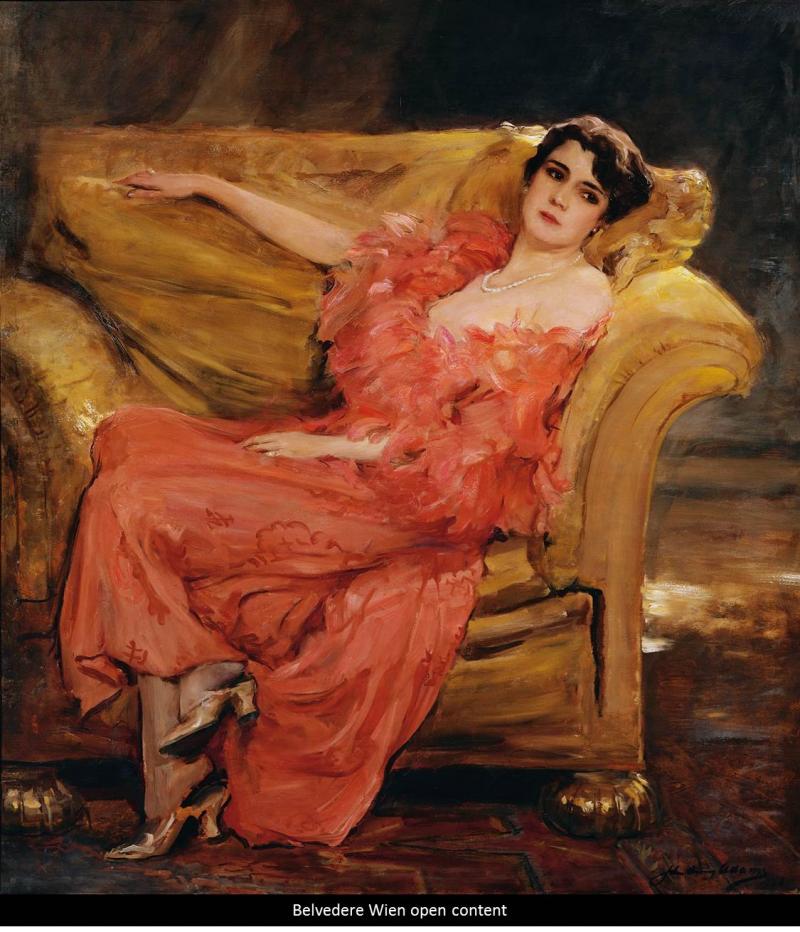

Luise Eisner 1926
Casual full-length portrait. The sitter is stretched sideways in a seated position in a large yellow chair, looking at the viewer; her right arm rests on the chair's back cushion, her left arm on her lap, her legs crossed, wearing golden slippers. Dress: red patterned silk dress with color-coordinated feather edging of the décolleté and a single-row pearl necklace and pearl ring. Living interior merely indicated by a carpet.
JQAW# P_1926_120
Oil on canvas 157 x 139 cm
Signature: John Quincy Ɑdams 1926
Belvedere Vienna Inv.No. 5554
Luise (Aloisia), née Fink, (1907) adopted Edle von Bartolommei d'Alda (also: Luise Fink-Bartolomei), through last marriage Princess Odescalchi (20.1.1887 Vienna to 13.3.1962 Vienna).
1st marriage (1908-1922) to aviation pioneer (Etrich Taube airplane) Ignaz Igo Etrich (1879-1967), 2nd marriage (1922-1938) to Berlin iron industrialist (Albert Hahn Röhrenwalzwerke) Paul Eisner (1886-1965), 3rd marriage (1949-1962) to Laszlo (Prince) Odescalchi de Szerém (1893-1967). Residences in Vienna and Kitzbühel (since 1934), deceased 1962 in Vienna and buried in the Odescalchi family crypt in Hiezig.
The portrait represents the epitome of Adams' glamorous female portrait style and anticipates the formal language of later "pin-up girls". The portrait was awarded the "Viennese People's Prize" at the 1926 Künstlerhaus exhibition, i.e. it was determined by visitor vote to be the most popular work and was published many times (including as the cover of the magazine Moderne Welt). The portrayed was a much described and depicted Viennese beauty (several photo portraits of Madame d'Ora, i.e. Dora Kallmus), married several times, who knew to combine her high-society lifestyle (for example as one of the first women to board an "Aeroplan" - an airplane prototype - in 1910) with charitable commitment (among other things as a lion tamer at a charity gala). In addition to her Adams portrait, which was bequeathed to the Belvedere, her charitable commitment lives on through two Luise Eisner-Odescalchi foundations in Kitzbühl and Vienna, which support needy children and young people.
During 2023-2026, the painting was the subject of restitution proceedings brought by the descendants of Paul Eisner’s sister; Paul Eisner, a Jew, was persecuted by the Nazis on racial grounds and was forced to flee into exile via Prague and Paris to Buenos Aires. At its meeting on May 12, 2026, the Art Restitution Advisory Board decided not to recommend the restitution of the painting, as there was no reason to doubt Luise Odescalchi’s ownership of her portrait, and it thus legally became part of the Belvedere’s collection through her bequest in 1963.
Cross-references
Luise Etrich (Eisner) 1910.
Luise Eisner Photo Atelier dÓra 1925.
Luise Eisner Atelier Loewy 1926.
The "covergirl":
Moderne Welt 1926.
Officiel de la Couture Oktober 1930 Photo Atelier d'Ora Paris.
Exhibited
1926 Künstlerhaus Vienna No. 2. (no entry in the entry book).
1984 Halbturn castle, Austria, Art in Austria 1918-1938.
1986 Academy Schillerplatz Vienna, Viennese Society in Portrait, Catalog No. 55.
Literature
Schaffer/Eisenburger 1986, exhibition catalog #55 (no ill.)
APH, catalog raisonné JQA 1995, p. 204, cat.#171, fig.#113.
Provenance
1926–1962 The sitter, Vienna and Kitzbühel.
1963 Bequeathed to the Belvedere, Vienna; Inv. No. 5554.
1963–1967 On loan to the sitter’s widower, Laszlo Odescalchi, Kitzbühel.
1967–2023 Belvedere, Vienna.
2023–2026 Subject to restitution proceedings, Belvedere, Vienna.
2026 Restitution claim denied; the work therefore remains at the Belvedere, Vienna.