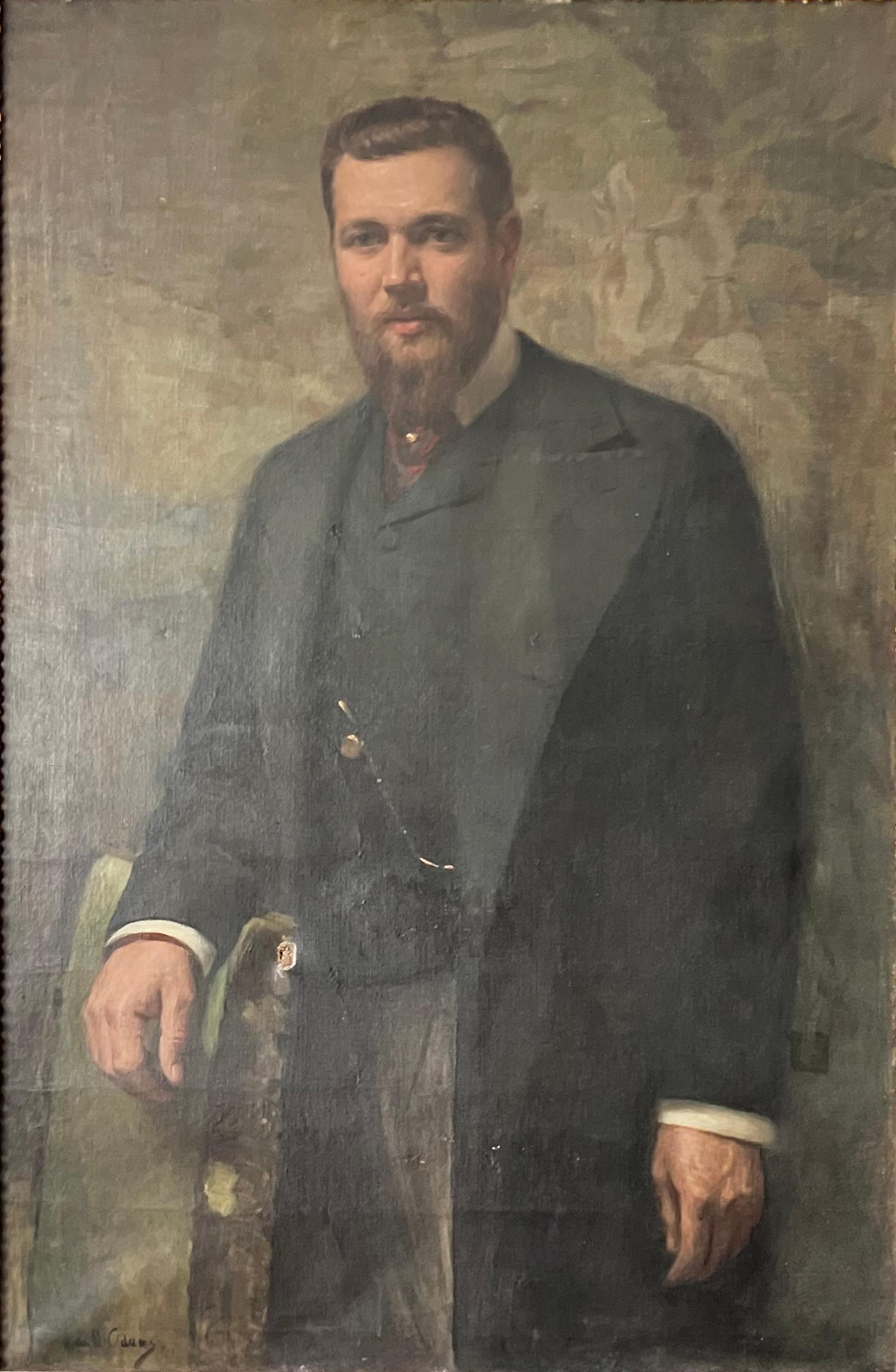
Dr. Friedrich Luithlen 1901
¾ portrait in standing position, slightly in profile, with the head and gaze turned toward the viewer; the forearm of his right hand rests on the backrest of an armchair upholstered in green fabric. The subject, with thick brown hair and a somewhat sparse full beard, wears gray trousers and a black vest, topped by a black frock coat with wide lapels, a burgundy tie with a pearl pin, and, as an accessory, a delicate gold watch chain with a gold medallion. Background: an abstract expanse of color in shades of brown and green, textured by brushstrokes.
JQAW# P_1901_040
Oil on canvas, 156 x 103 cm
Signed: John Q. Ɑdams 901.
Private collection, Austria
Illustration: Private photograph, condition as of 2026 (unrestored)
Dr. Friedrich Luithlen, September 14, 1869, Rodaun to June 18, 1927, Vienna; dermatologist, founder of a sanatorium, and a music lover with a passion for fencing; see also his entries in the biographical data bases ÖBL and Deutsche Biographie.
Friedrich Luithlen was the son of the progressive educators (August Julius) Viktor L. (1833–1887) and (Sofie Amalie Josephine) Marie L., née Haneke (1826–1893), who founded Vienna’s first higher school for girls in 1861, where his father also taught. After their mother’s death, his sister Martha L. (1866–1943) took over the leadership of the girls’ high school, while his brother, Dipl.Ing. Hugo L. (1871–1945), was a well-known railway engineer and senior civil servant.
After attending high school in Kremsmünster and Vienna, Friedrich studied medicine in Vienna beginning in 1888, where he earned his doctorate in medicine (Dr. med.) in 1894. Beginning in 1895, he completed his residency in dermatology and syphilology and qualified for university teaching (habilitation and Univ.Doz.) in 1904. In 1916, he became head of department at the Kaiser Franz Josef Clinic; in 1919, he was appointed associate professor at the University of Vienna. He devoted himself primarily to experimental pharmacological research, in the application of which to dermatology (including colloid therapy) he made pioneering contributions. Dr. Friedrich Luithlen gained widespread recognition both at home and abroad through his research and scientific publications (for example, he was invited to the United States in 1924 to give a series of lectures); for a tribute to his scientific and medical achievements, see his obituary in the Wiener Medizinischen Wochenschrift Nr. 26, 1927, S. 888-889.
It is noteworthy that Dr. Luithlen was also active as an entrepreneur. In 1907, he founded a corporation to build the “Dr. Luithlen Sanatorium”; its capital stock of 800,000 crowns was raised through the subscription of shares, primarily by members of the Viennese medical community, and was used to construct Vienna’s most modern sanatorium at Auerspergstrasse 9. The building, designed by Art Nouveau architect Robert Oerley (1876–1945), which opened on July 20, 1908, was groundbreaking in terms of technology (reinforced concrete construction), form (the absence of any facade ornamentation), and amenities (all patient rooms had their own bathrooms, electricity, and telephones). The otherwise unadorned building gained its distinctive character from the two glass domes on the roof, which housed the operating rooms—a feature also captured in postcards.
Originally, the sanatorium was used to treat skin and urinary tract diseases; it was directed by Dr. Luithlen (a dermatologist) and his deputy, Dr. Gustav Österreicher (a urologist). As early as 1910, Dr. Luithlen stepped down from the sanatorium’s leadership to devote more time to his experimental research. (His brother Hugo Luithlen, however, remained on the board of directors to represent the family’s interests.) The sanatorium began treating all types of medical conditions, expanded to include an X-ray facility, and changed its name to Santorium Auerspergstrasse—or, more simply, Sanatorium Auersperg. The list of prominent patients treated at the sanatorium is long and includes Sigmund Freud, Arthur Schnitzler, Mathilde, the wife of composer Arnold Schönberg, and actress Lilian Karczag-Marischka (see her portrait by Adams from 1927) among many others.
The relationship between Dr. Luithlen and John Quincy Adams comes to a close in 1927 with Dr. Luithlens death and finally in 1933. Suffering from stomach cancer, the artist spent his final weeks at the Auersperg Sanatorium, where he died on March 15, 1933.
Archival sources and contemporary newspaper reports provide insight into Dr. Friedrich Luithlen’s personal life. His first marriage (in 1895) to Bertha von Hempe ended in divorce. In 1914, Dr. Luithlen remarried the concert singer (alto) Florentine (Flora) Kalbeck (1882–1948), the daughter of the music critic and writer Max Kalbeck (1850–1921), who is known for his biography of Brahms. Three sons were born from his first marriage, and one daughter from his second. Dr. Luithlen was passionate about music, an enthusiasm he shared not only with his wife but also with his nephew (son of his brother Hugo), Victor Luithlen (1901–1987; see his Adams portrait from 1905 in the cross-references). Beginning in 1907, Dr. Luithlen was also an associate member of the Vienna Künstlerhaus (his admission was proposed by John Quincy Adams, Carl Baumann, and Hans Larwin). This allowed him to actively participate in the institution’s artistic and social events and to cultivate relationships with artists and friends of the Künstlerhaus. Dr. Luithlen also had an interest in sports. Like Adams, he was a member of the Vienna Union Fencing Club, where he achieved a number of sporting successes. For example, he (like Adams) won a silver medal at a fencing tournament in Vienna in 1904 (foil; Adams in saber; Sport und Salon, Dec. 24, 1904, p. 21). It can be assumed that the acquaintance—and likely also friendship—between Dr. Luithlen and Adams began at the Union Fencing Club and continued at the Vienna Künstlerhaus. His social interactions with artists, musicians, and prominent fellow athletes also enabled Dr. Luithlen to promote scientific interests. According to the OeBL, the founding of the Prince Johann Liechtenstein (see his 1908 portrait by Adams) Foundation for Scientific Research can be attributed to Dr. Luithlen’s initiative.
After a prolonged illness, Dr. Luitlen died of heart disease on June 18, 1927, at the age of only 58. At his request, the customary official obituaries and death notices were omitted, and his urn was interred in the presence of only his closest family. His grave is located at the Heiligenstadt Cemetery (A 13 113) in Vienna, where he rests alongside his wife Flora, his daughter Maria, and his son-in-law, Dr. Gustav Jelenko, a physician.
Adams’s portrait of Dr. Luithlen, dated 1901, is, in terms of signature and style, a characteristic early work by the artist; however, with its abstract background, it already foreshadows his later works. Despite the formal attire, the portrait exudes youthful charm and projects the artist’s sympathy for his subject. Dr. Luithlen is depicted with a full head of hair and a full beard—a portrayal that stands in stark contrast to the well-known later photographs of him (such as the iconic photographic portrait from the Atelier d’Ora in 1910), in which Dr. Luithlen sports a short, brushed haircut and a closely cropped mustache. It is likely that the painting was less a traditional commissioned work than a favor among fellow athletes at the Union Fencing Club. The extreme format (156 x 103 cm)—which Adams would use only later and for prominent subjects (e.g., the actress Helene Odilon in 1903)—and the associated amount of work involved suggest this.
The painting has been preserved in its original frame (a heavy, black Biedermeier frame with a piano-lacquer finish), on the back of which a handwritten note dated 1913 made it possible to identify the sitter. Only illegible rests of a second label remain, perhaps from a Künstlerhaus exhibition label. The portrait could possibly be identical to the portrait of a gentleman from a private collection exhibited at the Künstlerhaus in early 1901 (EL 43 1900/1901 #1262), which would suggest that the portrait would have to be created before January 19, 1901, the exhibition opening. The provenance of the painting is unknown and mysterious. The portrait likely remained in the family’s possession for a long time and, at an unknown point (the 1980s?), passed into the hands of a third party, where the family connection was lost and from which the painting was recently, presumably during the clearing out of an apartment, discarded. It was then offered for sale at the Naschmarkt flea market in Vienna alongside another Adams portrait (an oval portrait of a red-blonde lady, JQAW# P_1900_060), where it was discovered by its current owners—a young art-loving family with a keen eye for quality—and acquired for their art collection, which is currently being built up with a focus on the 19th century. (The young family was unable to purchase the Adams portrait of the lady; it was later offered for sale in November 2026 by an anonymous dealer on the secondhand marketplace willhaben.at.) The painting has thus finally returned to appreciative hands of art lovers, and, alongside Adams’s iconic 1909 work The Operation (see cross-references), Dr. Luithlens portrait represents another important documentary record of the influential Vienna Medical School around 1900.
Cross-references
Exhibited
Literature
Provenance
Unknown.
ca. 2025/26 purchased from anonymous seller at Vienna fleamarket,
private collection, Austria.