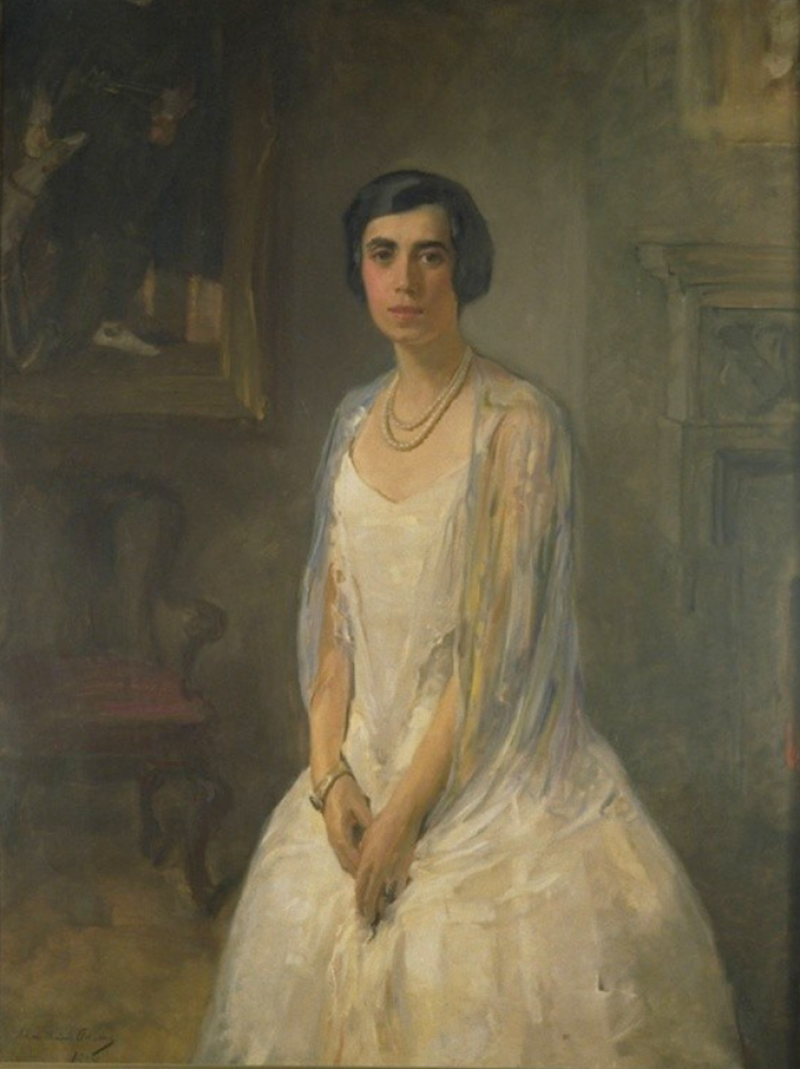
Lilly Steinschneider Codenhove-Kalergi 1924
¾ Portrait in standing position, slightly oblique view, hands clasped in front of her lap, head and gaze turned toward the viewer. The subject wears a long white sleeveless dress with a light blue chiffon overlay; around her neck is a double-stranded pearl necklace, on her right wrist a gold bangle with a black oval stone, and on her left hand a matching ring. Background: rich salon interior with a fireplace surround decorated with a coat of arms, an armchair, and two murals, one of which depicts a man in Renaissance costume with a greyhound.
Oil on canvas 140 x 108 cm
Signature: John Quincy Ɑdams 1924
Horšovský Týn castle (CZ) Inv.Nr. HT04915a
Ilka “Lilly/Lily” (Ilona Mária Magdolna) Steinschneider, married Countess Coudenhove-Kalergi von Ronspergheim, January 13, 1891, Budapest to March 28, 1975 or in 1977 in Nice or Geneva, racially persecuted Hungarian aviation pioneer.
Lilly was born in Budapest in 1891 into a Jewish family of factory owners. Her parents were Simon Bernát Steinschneider (1857–1923) and Irma St., née Wohl (1869–1935). She had three siblings (two brothers and one sister). Her independent spirit and interest in technology became apparent at an early age. In 1911, at the age of 20, she passed her driver's license test in Budapest and began pilot training in Wiener Neustadt (allegedly without her parents' knowledge or consent). She completed her first solo flight on December 14, 1911, in an Etrich Taube (see the catalog entry for Luise Eisner, who was married in her first marriage (1908-1913) to aircraft designer Ignaz Igo Etrich (1879-1967) and passed her pilot's exam in mid-August 1912, making her the first female pilot in Hungary (pilot's license from the Hungarian Aero Club No. 4). (The first woman in the world to obtain a pilot's license, on March 8, 1910, was the Frenchwoman Élise Léontine Deroche, Baroness Raymonde de Laroche [1882-1919], who became an early victim of her passion for flying. The first female pilot in the Austro-Hungarian Empire was the Czech Božena Láglerová, 1886-1941 [Austrian Aero Club pilot's license No. 37 dated October 10, 1911]. According to available information, Lilly was the 10th woman in the world to obtain a pilot's license.) Lilly was then employed as a pilot by the Austrian Motor Aircraft Company until March 1914 and took part in numerous air shows, safely piloting more than 700 passengers. The outbreak of World War I, which made private flights impossible, ended Lilly's career as a pilot. According to press reports (Neu.Wr. Journal 11/23/1916, p. 11), she served as a nurse on the Eastern Front during World War I, where she met her husband, Count Johannes “Hansi” Coudenhove-Kalergi. (It is more likely that the couple met in June 1914, before the outbreak of the World War, at the 3rd International Air Show in Aspern, where Lilly was a pilot and Count Hansi was a passenger in a daring triple loop maneuver by the Swiss Edmond Audemars [from the famous watchmaking dynasty]).
On October 13, 1913, Lilly was baptized in Budapest, thus converting to Catholicism. Her baptismal name was Ilona Mária Magdolna. On July 27, 1915, she married Count Johannes (Hansi) Coudenhove-Kalergi (since 1918 von Ronspergheim) (1893-1965) in Vienna (see his Adams portrait from 1924, cross-references). The marriage was not announced until 1916, probably due to resistance from the family. (This opposition was based on Lilly's bourgeois background. Anti-Semitism played no role, as the Coudenhove-Kalergi family was strongly influenced by Count Johannes' father, Dr. Heinrich C.K. (1859-1906), who had published the seminal scientific work “The Essence of Anti-Semitism” in 1901.) The newlyweds took up residence at Ronsperg Castle (Ronšperk, today called Pobìžovice), where Lilly cultivated an aristocratic lifestyle with her eccentric husband. Numerous trips, including for the treatment of her medical problems (operations in Vienna, Prague, and Berlin), as well as numerous automobiles (including car racing, such as a week-long endurance race across Czechoslovakia in July 1921), which became her new passion, meant that her stays in Ronsperg were rather short. Lilly also became interested in horse breeding and horse racing and became a member of the elite Jockey Club. It was not until late in the day, on June 22, 1927, that their only daughter, Maria Elekta (Thecla Elisabeth Christina Helena Sophia), known as “Pixie,” was born. Lilly took little interest in Pixie's upbringing, which, as was customary in aristocratic circles, was entrusted to governesses and, in Pixie's case, to the nuns of the Order of Sorores Misericordiae Sancti Caroli Borromei (SMCB), who ran a school in the village, which was modernized in 1936/37 with the support of the count's family (and which is depicted in the background of Offner's portrait of Lilly, see cross-references).
As a Jewish convert, Lilly had been in danger since the Nazis seized power in Germany in 1933. The Sudeten crisis in 1938, which led to the Munich Agreement and the incorporation of the Sudeten German territories (including Ronsperg) into the German Reich, was only the prelude to the subsequent occupation of the rest of Czechoslovakia in March 1939 and the accompanying persecution of political dissidents and people considered by the Nazis to be non-Aryans. The family probably feared such a development and took precautions. Lilly left Ronsperg in August 1938 and spent the following months traveling (Plavec, 2013). In 1939, she made her way to Rome via Hungary and found support from Catholic circles and the Vatican (probably through connections made by Count Hansi, who was a member of the Habsburg Order of St. George, a secular order of knights).
During Lilly's exile, a battle began to protect her daughter Pixie, who had remained with her father in Ronsperg. Count Hansi's goal was to have Pixie declared a second-degree Jewish half-breed in order to save her from deportation. To this end, he invented a story that Lilly was allegedly the illegitimate daughter of Count Heinrich Wenckheim (1857-1908) and documented corresponding witness statements from family friends (which is why Lilly is referred to as Steinschneider-Wenckheim in several sources). This would have made Lilly a first-degree Mischling and Pixie a second-degree Mischling. Count Hansi and his sister Olga also intervened with the Japanese ambassador in Berlin (his mother was known to be the Japanese Mitsuko Mitsu Coudenhove-Kalergi, née Aoyama 1874–1941), asking for support. Pixie was spared deportation (and murder), but had to perform forced labor in agriculture, a pattern of persecution that continued after 1945 (this time not as a Jew, but as a German speaker) until her deportation/departure to Germany. Under pressure from the Gestapo, Count Hansi declared the separation of the marriage on August 18, 1943, but it was not divorced by mutual consent until 1960.
Lilly survived the war in Rome and probably moved to southern France after 1950. Although some sources describe her life as marked by poverty, after her death (in 1975 or 1977) it emerged that she was quite wealthy (she left her daughter several condominiums, including one in Monte Carlo, as well as valuable jewelry), which can probably only be explained by generous donations from Ronsperg. Just like her life after the World War, her death is also shrouded in mystery. Various sources give Lilly's place of death as either Rome, Nice, or Geneva, and her date of death as either March 28, 1975, or 1977.
After being expelled from Czechoslovakia, her daughter Pixie lived in Germany, including with her father in Regensburg. Around 1950, she emigrated to the USA, where she called herself Marina Caglieri and became an American citizen in 1967/68. She kept her origins secret. It was only after her death in 2000 that a spectacular peridot jewelry set from around 1820 from the Habsburg family, which Archduchess Isabella wore in 1916 at the coronation of Emperor Karl as King of Hungary and which was purchased by the Coudenhoves at an auction in Vienna in 1936. The set fetched around $400,000 at Sotheby's auction in 2001. Lilly's eventful life as a racially persecuted aviation pioneer was financially secure, but nonetheless tragic: 1938-1945 saw a life in exile and uncertainty, followed by the break-up of her family with divorce and loss of contact with her daughter due to her emigration. Only her portraits (see cross-references) remain as evidence of an extraordinary personality and life story.
The Adams portrait from 1924 was intended for the ancestral gallery newly established by the eccentric Count Hansi at Ronsberg Castle and is very conventional and less successful. Exceptionally, Adams may have conformed to the client's ideas in the composition of the picture. The representational background of the painting is foreign to the artist's late style and also contradicts his painting style, in which expressionist brushstrokes blur the contours, and which is only reflected in Lilly's robe. In contrast, the portrait executed by Lino Vesco (1879-1935) in 1922 (see cross-references) or the portrait of Lilly as a pilot from around 1938-1944 (based on a photo from 1912) by Alfred Offner (1879-1947) see cross-references, convey Lilly's unconventional personality much better. Count Hansi was probably satisfied with the Adams portrait, as he later commissioned Alfred Offner to make a copy showing the convent built in 1936/37 in the background (the original has been lost, but a reproduction from the cover of the last issue of the Wiener Salonblatt from August 21, 1938 has been preserved, see cross-references).
Cross-references
Copy of the Adams portrait by Alfred Offner with changed background
Lillys Portrait by Lino Vesco
Lilly as pilot, portrait (before and after restauration) by Alfred Offner
Exhibited
Literature
Michal Plavec, 2013. Lilly Steinschneider. The First Hungarian Female Pilot of Jewish Origin. Judaica Bohemiae 1:55-78.
Provenance
Until 1945 with the sitter and her husband, Ronsperg castle (Poběžovice CZ).
1945 nationalized.
At unknown date moved to Horšovský Týn castle (CZ).
Horšovský Týn Inv.Nr. HT04915a.