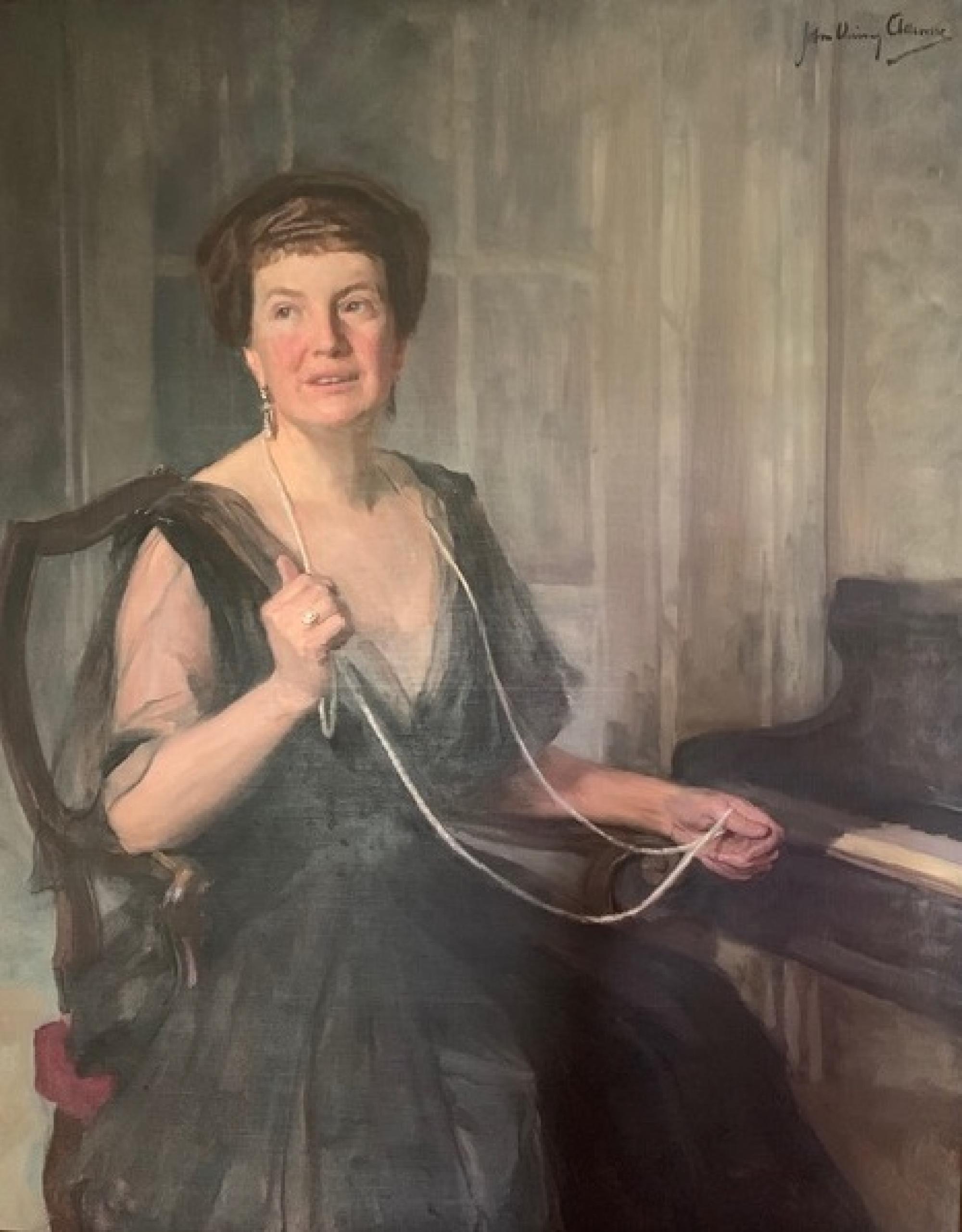
Margarete Countess Wurmbrand 1916/17
¾ Portrait in slight oblique view. The subject is seated next to a piano on a Biedermeier chair with an open backrest and a burgundy seat cushion. Her head is turned to the left, her gaze directed upward, not looking directly at the viewer. Her long pearl necklace is looped over the thumb of her left hand and held by her bent right hand. The sitter wears a V-neck, sleeveless black silk dress, topped with a black chiffon shawl, a long pearl necklace, a pearl ring, and teardrop-shaped pearl earrings. Background: A white lattice glass door with two panels (Adams’ studio at Theresianumgasse 11 Vienna).
JQAW# P_1917_150
Oil on canvas 85 x 60 (?) cm
Signature: John Quincy Ɑdams
Private collection, Austria
Image: Private (owner's) photograph
Margarete Countess Wurmbrand Stuppach, née von Schenk, November 25, 1872, Vienna – May 19, 1957, Prague. Passionate hunter, composer, and pianist.
Margarete was born on November 25, 1872, in Vienna and was baptized Evangelical AB on January 6, 1873, with the name Margarete Malvine Idaly von Schenk. As a sign of her parents’ high social status, her godparents included not only family members of her father and mother but also the Governor of Lower Austria, Count Erich Kielmannseg, and his wife Anastasia, a singer and composer.
Margarete’s mother, Johanna von Heiligenstaedt (Heiligenstädt/Heiligenstadt, 1844–1913), came from the East Prussian minor nobility and was born in Königsberg (today Kaliningrad, RU); her father, Ernst von Heiligenstaedt, was a cavalry captain, and her mother, Malvine, née von Bültzingslöwen, came from a Thuringian family of ancient nobility related to the Counts of Kielmannseg. Johanna von Heiligenstaedt pursued a career in music. Trained as a singer in Italy, she adopted the stage name Giovaninna Stella and was engaged as a singer at the city theater in Frankfurt am Main, among other venues. In 1868, she made her debut as Fräulein Stella at the Hofoper, and later also at the Carlstheater in Vienna. Her signature roles included Isabella in Meyerbeer’s Robert le Diable (her debut role in Vienna), the title role of Martha in Flotow’s opera of the same name, and Gabriele in Kreutzer’s opera Die Nachtwache. Her last documented public performance took place in May 1871 in Frankfurt. In September 1871, her engagement to Adolf Schenk was announced in Vienna. The wedding took place on October 3, 1871, in the form of a civil ceremony (still rather rare at the time) at Vienna City Hall, which was personally officiated by the Mayor of Vienna, Dr. Cajetan Felder (notably, Johanna declared herself to be “without [religious] affiliation” during the ceremony).
Margarete’s father was Adolf Schenk (1833–1919; ennobled in 1872 as Ritter von Schenk), who came from a lower-middle-class Jewish merchant family in Neustadt am Waag (Hungary, now Slovakia) and initially made his career in Vienna as a railway expert and official for the private southern railway company where he ultimately served as secretary to the director general. In 1862, together with his cousin of the same name, Adolf Schenk—who was elevated to the Hungarian nobility in 1883 as Schenk de Lédecz (and became the grandfather of the charismatic Countess Hilda Auersperg, portrayed by Adams in 1924)—he founded a trading firm that was primarily active in the timber and coal trade and made both partners very wealthy. In 1869, Adolf von Schenk was a co-founder and director of the private bank “Wiener Bank-Verein,” serving as its vice president from 1883 and president from 1906 (see his portrait by Philip de László, commissioned for this occasion). In addition, he also served on the supervisory boards of numerous companies. On December 14, 1886, he renounced Judaism and was baptized into the Evangelical AB Church as Johann Adolf Ritter von Schenk; on December 27, 1909, he was appointed a life member of the House of Lords (the upper house of Parliament). To testify his phenomenal economic and social rise, he purchased a property at Theresianumgasse 21 (corner of Argentinierstrasse) for 200,000 guilders in 1887 and had the private Palais Schenk built by the architectural firm Fellner & Helmer between 1888 and 1890. Later also known as Palais Wurmbrand, it has been owned by the Spanish state since 1920 (purchase agreement dated June 11, 1920) and houses the Spanish Embassy. Renovated and expanded in a somewhat simplified style following severe bomb damage in 1945 (see image comparison 1906/2026), it continues to grace the Viennese cityscape still today. (The even more opulent Rothschild family palaces located in the immediate vicinity were also damaged during the war, but were subsequently demolished and replaced by new buildings for the Austrian Chamber of Labor.) Sandgruber (Traumzeit, 2013, p. 430) lists Adolf von Schenk as the 88th-richest Viennese in 1910 with a taxable income of around 450,000 crowns (roughly 450 times the annual wage of a skilled worker—which, given today’s [much higher real wage levels], would correspond to more than 10 million euros).
The legacy that Margarete inherited from her parents thus consisted, on her mother’s side, of her musicality and, on her father’s side, of a vast fortune.
There are no detailed sources available regarding Margarete’s childhood. She lived with her parents initially in upper-class rental apartments in the 1st district (until 1872 at Walfischgasse 8, 1873–1889 at Elisabethstraße 16) and, starting in 1890, in the family-owned Palais Schenk in the 4th district, and was likely taught by private tutors. It is known that, after initial lessons from her mother, Margarete received her musical education from well-known Viennese female music teachers: Prof. Bruckner and Gisela von Ehrenstein, who also taught Margarete’s daughter Huberta. Margarete made her first public musical appearance on March 27, 1886, at a musical soirée organized by Prof. Bruckner for her students in the Streicher Hall, which was built in 1812 and was inaugurated by Beethoven. In addition to her musical talents, Margarete also developed an interest in sports; in 1883, at the age of 11, she joined the Vienna Skating Club. After her marriage, she became a passionate hunter and breeder of hunting dogs.
On November 25, 1890, Margarete became engaged to Hereditary Count Wilhelm Ernst Wurmbrand Stuppach (1862–1927), who served as a first lieutenant in the 12th Dragoon Regiment. The wedding took place on May 27, 1891, at Vienna’s Votivkirche; the bride’s witnesses were her father Adolf and (once again) Count Kielmannseg, while the groom’s witnesses were Prince Windischgraetz and his uncle Count Hermann Wurmbrand Stuppach.
The Counts of Wurmbrand Stuppach are a family documented since the 12th century and belong to the Austrian high nobility. The name Wurmbrand derives from a legend of a fire-breathing lindworm; the suffix Stuppach refers to the family’s first ancestral seat (until 1659), Stuppach Castle (which is known for being the site where Count Walsegg commissioned and first performed Mozart’s Requiem in 1791). The family’s later ancestral seat became Steyersberg Castle in Lower Austria, which has been owned by the Wurmbrands since 1600.
According to the social conventions of the time, a marriage between the daughter of a “newly wealthy” Jewish convert with a recent minor title of nobility with a hereditary count from a centuries-old family of the high nobility was considered beneath his station. Nonetheless, such unions are documented on multiple occasions within the wider Wurmbrand family and also in other families of the high aristocracy. The union between Margarete and Wilhelm served, on the one hand, the Schenk family’s desire for social advancement and, on the other, the Wurmbrands’ need to restore the family’s likely disastrous finances (as one descendant put it: “The Wurmbrands and Tintis always spent more than they earned”). Details point to the actual balance of power in this marriage: contrary to customary practice, Margarete did not convert to her husband’s Catholic faith but retained her protestant denomination; Equally noteworthy is that Wilhelm’s best man was not his father, Count Ferdinand Gundaccar W-St. (1835–1896), but his uncle Hermann W-St. (1836–1901), which can be interpreted as a sign of disapproval on the part of the father. And yet, the marriage can be seen as a mutual win-win situation. Margarete became Countess Wurmbrand Stuppach with the title “Her Excellency” (regarding the confusing name identity of three Countesses Margarete Wurmbrand, see footnote [1]). Margarete’s dowry must have been more than substantial and most welcome. As early as 1893, extensive renovations and additions were carried out on the so-called New Castle of the Steyersberg Castle complex (testified, according to Burgen Austria, by the dated Wurmbrand-Schenk alliance coat of arms). In 1896, the stately farmstead/administrative building for the castle and the family’s vast land holdings, a pentagonal building in the romantic castle style, was constructed by the firm Helmer & Fellner (who had also worked on the Palais Schenk in Vienna). Furthermore, Margarete quickly adapted to the interests and lifestyle of her husband, who was known for his passion for hunting and was a leading figure in the hunting community in Austria (President of the Lower Austria and Vienna Hunting Association, the Hunting Club, and a key proponent of the construction of the Emperor Franz Josef Hunter’s Monument in Bad Ischl, which was inaugurated in 1910). Margarete apparently also turned a blind eye to her husband’s extramarital escapades (which came to light in 1902 during a defamation trial, Ostdeutsche Rundschau, August 8, 1902, p. 14).
The marriage was blessed with three children: Huberta (1892–1967), Degenhart (1893–1965), and Ernst (1897–1960). Direct descendants of the family trace back to three of Margarete’s grandchildren: (U.S. branch) through Degenhart’s only child, his daughter Leonora (“Lori”), married name Miller, and (after her divorce) von Wertheimstein (1927–2009); and (Czech branch) through Huberta’s children Marie Jana, married name Laxa (1919–2009), and Christoph/Kryštof (1927–1999) Kolowrat.
The decade following Margarete’s marriage passed quietly, with no public appearances. The young couple apparently did not have a permanent primary residence, as all their children were born in different locations: Huberta in 1892 (Mauer near Vienna), Count Degenhart in 1893 (at Krummnußbaum Castle, which belonged to the Barons von Tinti, who were related to the Wurmbrands through double marriage between two Wurmbrand sisters and two Tinti brothers) and Ernst in 1897 (Steyersberg, which her husband Wilhelm took over as head of the House of Wurmbrand after his father’s death in 1896). During this time, in addition to caring for her children, Margarete devoted herself primarily to her newly discovered hunting interests. She developed into an outstanding markswoman and passionate hunter, and also dedicated herself to breeding hunting dogs (dachshunds) at her kennel “Forst.” Her hunting trophies won numerous prizes at the hunting exhibitions popular at the time (such as in 1900, 1911, and 1912), and her hunting bag was also reported in the press (Für’s Jagdschloss, September 1903, p. 1). In 1902/03, she bagged (by today’s standards, an excessive number of) 3,059 game animals (20 stags and chamois, 300 roe deer, 120 pheasants, and more than 2,000 hares and partridges). Margarete was thus one of the few women who earned fame and recognition in the male-dominated hunting community around 1900 (along with her female counterparts Valentine Rothschild-Springer, Margret Krupp, Mary von Stern, and Esperence Solms-Braunfels, Neu.Wr.Journal July 16, 1922, pp. 7–8).
After 1901, Margarete also made more frequent public appearances. She served as patroness at numerous events such as balls, soirees, and artistic evenings that combined musical, literary, and visual art contributions into a “Gesamtkunstwerk”. (The visual arts frequently contributed “living pictures,” where prominent socialites portrayed a work of art designed by a leading artist on stage; the designing artists included also John Quincy Adams, e.g. in 1914 at a concert soiree at the Vienna Musikverein.) The role of the patronesses was, on the one hand, to signal the event’s social distinction (a large number of prominent patronesses heightened the significance of an event and was widely publicized; the entrance of the patronesses following the members of the ruling house, led by prominent socialites [usually not the spouses of the patronesses], also marked the opening of an event). Patronesses also served practical functions: they supported the event by selling tickets, organized “stations” where refreshments, pastries, or flowers were sold, and entertained the guests—in Margarete’s case, also with musical interludes (as in 1913 at a charity auction in the Blumensäle, where Margarete organized a bar and entertained the guests at the piano with Viennese songs). As a rule, the proceeds from such events went to charitable causes, which socially legitimized the patronesses’ honorary duties. (Otherwise, an aristocratic lady would never have been able to act as a waitress or flower seller, even in a private setting.)
Fixed events on Margarete’s social calendar included, above all, the ball of the Green Cross Society (“Hunters’ Ball”, an annual event that continues to today), to support impoverished professional hunters and their widows and orphans, the White Cross Society (to support war veterans) ball, and the Vienna Volunteer Rescue Society (forerunner of the Red Cross) ball, among many others. “Must-attend events” without a charitable background included, above all, the “Vienna Derby” (a horse race), which marked the highlight of the social calendar before the departure for the summer retreat. All these events provided an opportunity to publicly display social status and personal taste through elaborate gowns and precious jewelry (in Margarethe’s case, diamond tiaras and pearls), which were widely reported on in the press. In Margarete’s case, the gowns were often so extravagant that they were even illustrated in the press by fashion illustrators (see an example from the 1913 Hunters’ Ball, Neu.Wr. Journal, Jan. 19, 1913, p. 11), though the distinction between an extravagant ball gown and a carnival costume is not always easy to make. For example, in 1910 Margarete appeared at the ball of the Volunteer Rescue Society as “White Pearl”: her gown and gloves were richly embroidered with pearls, and she wore a pearl-embroidered headpiece in the shape of a pearl, illustrating Margarete’s fondness for pearls, which are also depicted in her Adams portrait.
Charitable musical events such as concerts, soirees, and musical tea parties—which were organized with increasing frequency especially during the early years of WWI, 1914–1916—also gave Margarete the opportunity to appear in public as a pianist, composer, and lyricist. Her musical repertoire was broad and included concertos, sonatas, and songs by composers of the Classical period (Beethoven), Romantic (Schubert, Schumann, Grieg, Brahms), but also, notably, contemporary music (Korngold, Richard Strauss; Margarete’s love for the works of Gustav Mahler is also documented)— see the tabular overview of Margarete’s concert performances, programs, and performers.
Margarete’s openness to new musical trends is also documented by a performance at a charity event at the Hungarian Embassy on January 28, 1923, where she performed with an ensemble of musician friends as a jazz band and delighted the audience with modern dance tunes (shimmies). In view of the traditional Gypsy band also performing, Margarete is said to have remarked with dry humor: “That’s the competition. I wonder who will get more applause at the festival—them or us?”
Friends and family members often participated in these musical performances, which took also place in her parents’ Palais Schenk (see a related press report by Elsa Tauber from 1916). Family co-musicians included her daughter Huberta and Adelma Tinti, the daughter of her sister-in-law Henriette Wurmbrand, married name von Tinti, both of whom were also portrayed by Adams. Margarete was also active as a composer. She published her first songs (“Das Drah’n ist eine Lust” and “Blaue Augen”) under the pseudonym “M von Weyersberg.” In 1916, Margarete published two “war songs” under her own name (see the score), which she dedicated to her sons serving in the war (her husband Wilhelm also returned from reserve to active duty). According to available sources, these songs were each performed publicly with Margarete’s piano accompaniment on March 31, 1916 (sung by Josefine Glöckner-Kramer), on April 9, 1916 (sung by Huberta Wurmbrand), and on May 15, 1918 (sung by Agnes Prycht-Pyllemann). Margarete’s waltz song “Auf Urlaub” (on home leave, lyrics by Leo Leipziger) was performed in 2026 for the first time in over 100 years by a U.S.-Austrian amateur ensemble recruited by the editor (reflecting Adams’ biography) (and can be heard via this audio link). The recording is intended to introduce the reader to the composer Margarete Wurmbrand and to pay tribute to this remarkable woman and musician.
Margarete also published a series of feature articles in the daily press (Die Presse, Fremdenblatt, Neues Wiener Journal) where she expressed her views on various topics, such as fashion or the economic situation during and after World War I. There she noted the incipient impoverishment of the population and called for a new modesty in the social conduct of the elites—a practice that was, out of necessity, adopted after the war and the period of hyperinflation. For example, after the war, the dress code at the Hunters’ ball shifted towards simpler traditional attire (Dirndl, hunting/Styrian suits), a tradition that continues to this day. Particularly moving is an article that Margarete published in 1919 in the Neues Wiener Journal, in which she lamented the (economically) “dying Vienna” and its effects on Vienna’s musical life, particularly the impending emigration of the Rose Quartet. (The Rose Quartet, however, did not leave Vienna until 1938 and then not out of economic reasons but due to racial persecution by the Nazis following the Anschluss, i.e. the annihilation of Austria.)
The Wurmbrands were not spared from economic decline either. The assets they had invested in war bonds were lost after the war, and the onset of hyperinflation—which could not be brought under control until the currency reform and the introduction of the gold-standard-backed Schilling (“Alpendollar”) in 1925—led to a drastic reduction in private consumption. The loss of the monarchy’s common economic area and the protectionist trade policies of the successor states reduced trade and led to job losses in the export industry and shortages of imported energy and food. With the onset of the Great Depression in 1929, mass unemployment was accompanied by a collapse in prices for agricultural goods and timber—the main sources of income for large landowners, i.e. the aristocracy and the monasteries. Monasteries were forced to sell invaluable cultural treasures abroad (primarily to the U.S. – the Gutenberg bible on which U.S. presidents usually take their oath of office originally comes from the Austrian monastery St. Paul). Aristocratic land-owners needed to take on debt or liquidate assets. In 1920, shortly after the death of her father (who had fallen victim to the global flu pandemic in 1919), Margarete sold the family palace in Vienna to the Spanish government (it has served as the Spanish Embassy ever since), a sale that was economically unwise at the onset of hyperinflation but was likely forced by the once again catastrophic Wurmbrand finances and brought only temporary relief. (Margarete continued to maintain a residence in Vienna during the 1920s, a rented apartment in the posh Toscanahof near the former family palace.) After the onset of the Great Depression in 1929, her son Degenhart, who had succeeded to the estate in 1927, also fell into financial difficulties. A newspaper commentary in 1934 cynically assessed his financial situation, noting that the value of the trees in the Wurmbrand forests was limited to the fact that the owner could use them to hang himself. In 1936, the Wurmbrand entailed estate was “sequestered” (placed under receivership) due to excessive debt, and the sale of real estate not protected by the deed of foundation was ordered by the court.
Despite drastic social changes (the abolition of all noble titles and privileges in 1919) and economic deterioration, Margarete’s life in the 10 years following the end of WWI remained privileged and joyful. She continued to indulge her passion for hunting and also attended social events again (especially the Hunters’ Ball), albeit to a lesser extent. Margarete’s children were a source of joy. On October 12, 1918, her daughter Huberta married the Bohemian diplomat and lawyer Count Jan Hanuš (“Hansi”) Kolowrat-Krakowský-Liebštejnský (1879–1955) in Vienna, and on July 30, 1919, her granddaughter Johanna/Jana (“Hannerl” 1919–2006) was born. Although Huberta took up residence with her husband at Cernovice Castle in Bohemia, she remained close to her mother. On May 15, 1926, Margarete's son Degenhart married Lawton Filer (1903–1998), the daughter of an American millionaire, in Paris—an event to which Margarete traveled with her son Ernst (who remained unmarried throughout his life). On April 11, 1927, granddaughter Leonore/“Lori” Wurmbrand (1927–2009) was born in New York, and on June 21, 1927, grandson Kryštof Kolowrat (1927–1999). However, since her son Degenhart lived mainly abroad (in Paris and San Francisco), contact with his family was limited.
On December 7, 1927, her husband Wilhelm died of a heart attack while hunting. Afterward, Margarete largely withdrew from public life and retired to Steyersberg Castle. Only regular reciprocal visits from and with her daughter Huberta, son-in-law Hanus, and the grandchildren, alternating between Steyersberg and Cernovice, as well as rare visits to Vienna for lectures and concerts (though no more balls), provided a change of pace.
In 1938, Margarete was 66 years old and should have been looking forward to a peaceful old age. However, the political upheavals associated with the rise of fascism in Europe, the ensuing Second World War, and the subsequent geopolitical shifts with the rise of communism and the emergence of the Iron Curtain led to a dramatic turning point in Margarete’s life. The foundation of her social existence and identity—that is, her (Jewish) family roots, her (German) mother tongue, and her social status (as a member of the high aristocracy)—which had previously shaped and privileged her life, suddenly became a source of political persecution, danger, and constant insecurity, regardless of the regime in power at the time (Nazis, the restored Czechoslovak Republic, or Communists).
With the “Anschluss” (i.e., the annexation of Austria) on March 13, 1938, and the onset of racial persecution by the Nazis, her ancestry suddenly became a matter of interest, as evidenced by the inquiries recorded in her baptismal records and those of her father on June 19 and December 30, 1938. To the Nazis, Margarete was considered a “first-degree Jewish half-breed” due to her father—who was born Jewish but later converted—and his parents; such individuals were subject to forced labor and, under certain circumstances, could also be deported to concentration camps. Margarete therefore moved from Austria to join her daughter Huberta and son-in-law Hanuš at Cernovice Castle in the Czech Republic, being officially registered there with the police since 1940. (Cernovice Castle was built by the Kolowrat family around 1820 as a rather modest two-winged complex to serve as a summer residence. Their ancestral seat is the nearby Castle in Rychnov nad Kněžnou, which is considered the largest Baroque castle in Bohemia and formed the center of the Kolowrat entailed estate, spanning over 7,000 hectares. In 1934, Hanuš renounced his claim to the inheritance in favor of his younger brother Zdeněk (1881–1941), on the condition that upon Zdeněk’s death, the inheritance would pass to his own son Kryštof (1927–1999). Hanuš retained only Cernovice Castle as a residence for himself and his family.) However, this relocation offered Margarete only brief protection, as following the annexation of the Sudeten German territories in the fall of 1938, the remainder of Czechoslovakia was also occupied by German troops on March 15, 1939, and her son-in-law Hanuš, as a Czech patriot, was politically extremely vulnerable (he and his three brothers had signed the declarations of loyalty by the Czech nobility to the Republic—which then, after 1989, served as the basis for the restitution of noble estates [and their Adams family portraits] to patriotic noble families such as the Kolowrats, Kinskys, or Parishes). Hanuš’ estates were placed under forced administration, and Cernovice Castle was requisitioned. However, the family and Margarete were allowed to continue living in a side wing of the castle. The danger of arrest and deportation, however, was ever-present during the German occupation.
Although 1945 brought the end of the World War and the Nazi occupation, the Beneš Decrees—which led to the expropriation and expulsion of approximately 3 million German-speaking residents of Czechoslovakia—posed a renewed threat of arrest and deportation for Margarete (her Austrian citizenship is noted explicitly in her police registration records from 1945). It can be assumed, however, that Hanuš’s rehabilitation and the restitution of the Kolowrat estate by the new Czech government offered her a certain degree of protection.
With the communists’ seizure of power in 1948, the situation became precarious once again for Margarete as both a “German” and now also as an aristocratic “class enemy.” As early as 1948, the Kolowrats were expropriated once again, and the family, including Margarete, was evicted from Cernovice Castle. They found refuge with their friend Alžběta Dobrzenská, née von Wenckheim (1888–1964) in her villa in Potštejn, but were politically persecuted and harassed. In 1953, Hanuš, Huberta, and their son Kryštof were arrested. Huberta was imprisoned for a year in Prague’s Pankrác Prison without trial. Following the amnesty in 1954, the family was released, but Hanuš and Kryštof were conscripted into agricultural and forestry work, respectively. Hanuš died in 1955 in Rychnov; Kryštof lived with his young family in a forest cabin as a forester (the family emigrated to Austria in 1968 following the suppression of the “Prague Spring” and did not return until after the 1989 “Velvet Revolution”). Margarete died shortly before her 85th birthday on May 19, 1957, in Prague. Within the next 10 years, her three children also passed away: son Ernst in 1960, and son Degenhart in 1965. In 1961, daughter Huberta managed to leave for Austria, where she lived at Steyersberg Castle and died in 1967.
The life of Margarete and her family exemplifies the splendor and misery of the 20th century, which led from the “Age of Security” (Stefan Zweig) into a “new” era of wars, crises, insecurity, persecution, and repression.
Adams’ portrait of Countess Margarete Wurmbrand is undated, but was likely painted around the turn of the year 1916/1917 in Adams’ studio in Vienna. At the same time, he also created a portrait study of her 24-year-old daughter Huberta with her favorite dog. Margarete’s portrait was presented to the public by Adams at his group exhibition at the Vienna Künstlerhaus in 1917. Margarete and her husband Wilhelm attended the preview of the exhibition in person on February 24, 1917 (Deutsches Volksblatt, February 25, 1917, p. 11). The conventionally composed portrait, in which the subject is shown seated at the piano, is, however, of particular charm due to the superbly captured surprised (and somewhat startled) facial expression. The masterfully rendered dynamic movement in which the subject turns to the left, turning away from the piano, raises her head, and looks upward while clutching her long pearl necklace with both hands, is particularly captivating and was also correspondingly praised by critics (Neues Wr. Tagblatt, March 8, 1917, p. 11). The depiction of movement in a portrait (which is inherently static) succeeds only extremely rarely. In this regard, Margarete’s portrait, alongside the iconic painting The Operation from 1909, is unique in Adams’s body of work.
Footnote 1: Intricate family connections of those portrayed by Adams:
In the generation of the subject of the 1916/17 portrait Margarete II Wurmbrand Stuppach, née von Schenk (1872–1957), there are two others with the same name: Margarethe I Wurmbrand Stuppach, married Baroness von Tinti (1870–1938), the sister-in-law of Margarete II, who was portrayed by Adams around 1913; and Margarete III Wurmbrand Stuppach, née Spitzer (1886–1952), the wife of Gundaccar Ferdinand Wurmbrand Stuppach (1863–1933), a third cousin of Wilhelm Ernst Wurmbrand Stuppach (1862–1927), the husband of Margarete II. His sisters Margarethe I Josephine (1870–1938) and Henriette/Henrike Aemiliana/Emilie (1864–1920) Wurmbrand Stuppach were married to the brothers Arthur (1862–1917) and Karl Ferdinand (1859–1914), Barons von Tinti. Adelma Tinti (1892–1966), also portrayed by Adams around 1916/1917, was the daughter of Henriette and Karl von Tinti. Huberta Wurmbrand Stuppach (1892–1967), portrayed in 1916/17 (see cross-references), was the daughter of Wilhelm Ernst and Margarete II Wurmbrand Stuppach, née von Schenk.
Acknowledgments: Thanks go to the descendants of the sitters’ grandchildren, R.M. and J.L., for providing a photo of the portrait and for information about the family. Special thanks go to the friends Christian Maedel, Arthur Munkenbeck, and Tom Murphy, who, together with the editor, performed and recorded the Wurmbrand song “Auf Urlaub” in 2026 for the first time since more than 100 years.
Cross-references
Huberta Wurmbrand 1916/1917 (daughter)Exhibited
1917 Künstlerhaus Vienna, collective exhibition John Quincy Adams No. 12 (EL 61 1916/17 #501).
Literature
Roman Sandgruber - Traumzeit für Millionäre, die 929 reichsten Wienerinnen und Wiener im Jahre 1910, Styria, WIen, 2013, 495 pp.
Provenance
The sitter, and her family descendants,
private collection Austria.