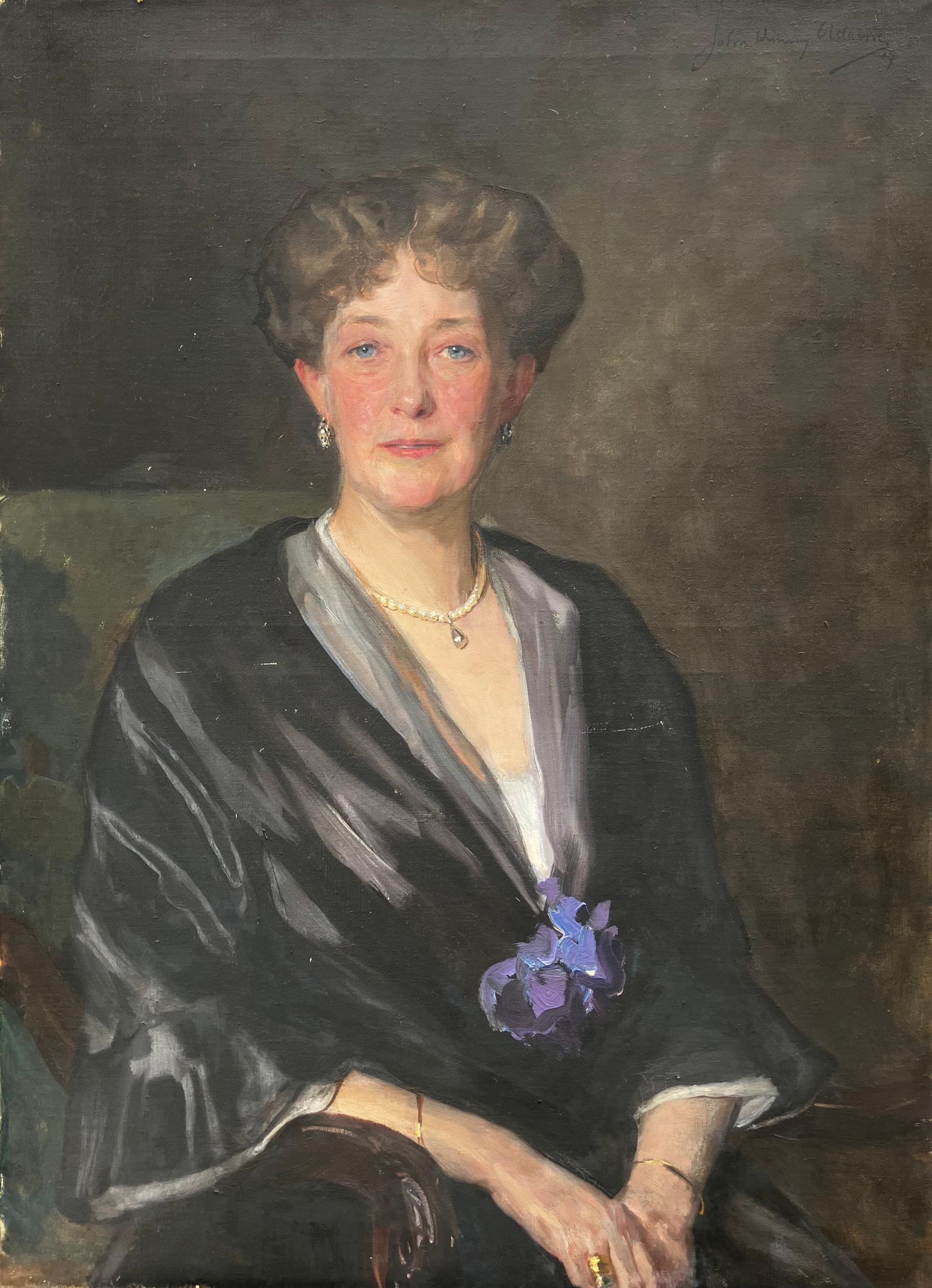
Marietta Ungnadin Countess von Weissenwolff 1917
Half-length portrait in a seated position, slightly oblique view, head turned toward the viewer, looking directly at him with blue eyes. The subject is seated in a high armchair upholstered in tapestry fabric, her forearms resting on the armrests, her hands resting in her lap. Her hair is pinned up with a center parting and she is dressed in a black silk dress with white lining, a light gray collar, and a blue-violet fabric flower at the neckline. She wears a short single-strand pearl necklace with a teardrop-shaped diamond pendant, diamond earrings, slim gold bracelets on both arms, and a wide gold ring and a diamond ring on the ring finger of her right hand. Background: abstract coloring in shades of brown, gray, and black.
JQAW# P_1917_110
Oil on canvass 90 x 65 cm
Signature: John Quincy Ɑdams 17
Private collection Austria
Picture: private photograph 2025
Marietta (Maria Eva Clara Carolina Camilla Wilhelmina Johanna) Ungnadin Countess von Weissenwolff, née Countess von Starhemberg, 24 November1860 Bergheim to 31 July 1940 Steyregg, the last of the von Weissenwolff.
Marietta was born into the Starhemberg family in 1860 at Bergheim Castle, not far from Linz. The Starhembergs are one of Austria's so-called apostle families, i.e., noble families that were already resident in Austria during the Babenberg era (before 1246). Of the original 18 apostolic families, six still exist today (members of five of these families were portrayed by Adams). The Starhembergs were elevated to the rank of Imperial Counts in 1643 and Imperial Princes in 1765. (The head of the house bears the title of Prince, while all other family members bear the title of Count, including Marietta).
In May 1879, the engagement of 19-year-old Marietta to Count Konrad/Conrad Ungnad von Weissenwolff (1855-1912) was announced in Meran (Merano, IT); the wedding took place on August 2, 1879, in Vienna's Votivkirche. The two noble families were already related through intermarriage in the 16th and 18th centuries. The Ungnad von Weissenwolff family is a noble family that is documented in Carinthia as early as the 12th century and settled in Upper Austria after 1600 (for the legend of the origin of the “Ungnad” [Disfavor/Disgrace] epithet [that precedes the title] in the 13th century, see the Wikipedia entry). Their ancestral seat is Steyregg Castle (still owned by the family) and Steyregg Palace (destroyed by bombs in 1945). The name Weissenwolff is also immortalized in music history. Franz Schubert dedicated his song cycle Op. 52, based on Sir Walter Scott's poem “The Lady of the Lake,” to Countess Sophie von Weissenwolff, née Countess Breunner (1794–1847), the great-aunt of Konrad von Weissenwolff. The work was premiered in Steyregg Castle. Ellen's third song, the hymn to the Virgin Mary, has become immortalized in the musical canon as Schubert's Ave Maria D839. Also worth mentioning is the connection to art history: the Danube and Steyregg Castle have inspired numerous painters, including (Joseph Mallord) William Turner (1775-1881), who in 1840 made sketches along the Danube with a view of “Steyerbourg” and the Weissenwolff castle ruins at Spilberg.
Marietta and Konrad's marriage was blessed with five children: two daughters (Irene, 1880-1969; Henriette, 1883-1962) and three sons (Paul, 1886-1915; Johann, 1890-1893; Nikolaus, 1895-1917). However, their fate was overshadowed by a series of tragic deaths due to accidents and infectious diseases, which can be treated with antibiotics today but at that time almost always led to death. These deaths led to the extinction of the Weissenwolff family in the male line (see below), which is why Marietta is also characterized here as the “last Weissenwolff.” (The name actually lives on since an adoption in 1944 with the Counts Salm-Reifferscheidt-Ungnad-Weissenwolff.)
Konrad and Marietta had close ties to the Austrian Imperial family. Marietta served as a lady-in-waiting (to Empress Sisi), was a recipient of the Order of the Starcross (the highest order for women in the monarchy), and was an honorary lady of the Order of Malta. Konrad was a Privy Councilor and Chamberlain (titles that signaled direct access to the court and the emperor), a member of the House of Lords (1899-1912), a member of the Upper Austrian Provincial Parliament (1896-1902), honorary knight of the Order of Malta, and holder of other civil offices (president of the Upper Austrian Hunting Association, the Red Cross, and the Art Association). He also served several times as an escort to members of the Imperial family. In May 1888, Konrad and Marietta accompanied Archduke Johann Salvator (later Johann Orth) on an Adriatic cruise on his yacht (Linzer Tagespost, May 3, 1888, p. 3). The social highlight was probably the debut (official introduction into society) of their two daughters Irene and Henriette in 1903 at the imperial court ball, as well as at the Vienna Art Walks and the Hoyos Ball Festival. Charity events such as the Green Cross Ball (Hunters' Ball) in Vienna or the Red Cross balls in Linz were regular fixtures in Konrad and Marietta's social calendar. Family celebrations (see cross-references), travel and spa stays, or hunting (even on other continents) in Konrad's case, were also characteristic features of the aristocratic lifestyle of the time.
However, these public roles shed no light on Marietta's personality and character. An attempt is made to capture this by looking at family and economic developments, which paint a picture of a personality characterized by strong faith, willpower, and family values. Faith is the basis for enduring numerous tragic blows of fate; willpower and family values characterize the (successful) efforts to preserve inherited family property as much as possible in difficult times and to pass it on fairly to future generations.
Marietta suffered many blows of fate. In 1893, her three-year-old son “Hansi” (Johann) died of typhoid fever. The family took this as an opportunity to build a new family crypt next to the Steyregg cemetery, which was inaugurated in 1894 and into which Hansi's body was reburied in 1895. In 1912, her husband Konrad died of pneumonia at the age of only 59, after catching a chill while hunting deer. In 1915, their son Paul died in military service (in a railway accident while on courier duty in Hungary, in which he was virtually decapitated) and their son-in-law Hugo Prince of Thurn and Taxis died (from a gunshot wound he suffered on the Eastern Front). In 1917, during a visit to the newly acquired estates and castle in Kopidlno in Bohemia, her son Nikolaus died of an infection following an appendectomy in Prague. This marked the end of the male line of the Weissenwolff family. The family continued for two generations through the female line: daughter Irene, married name Szapáry, remained childless; daughter Henriette, married name Thurn und Taxis, had three daughters: Maria Antonie Henriette, Antonie Irene, and Irene Marie Clothilde, all of whom had descendants. In 1962, Antonie Irene and her two daughters Marietta and Beatrix were killed in a tragic traffic accident.
The extinction of the male line of the Weissenwolff family in 1917 and the collapse of the monarchy in 1918/19 deprived the family of the traditional economic model for preserving and passing on their estates from generation to generation: the principle of primogeniture (the eldest son is the sole heir) and the instrument of the fideicommissum (a foundation), which entitled the heirs to use the assets but not to sell them. In addition, the economic situation after World War I was catastrophic: hyperinflation, followed by economic depression and falling prices for agricultural products and timber, which formed the economic basis of aristocratic holdings. Marietta therefore had to prove herself as administrator of the Weissenwolff estate in difficult times, which was a challenge given her traditional upbringing and the role expectations of female members of the aristocracy in the monarchy.
However, the family's economic base was impressive: their land holdings in Austria amounted to more than 2,000 hectares, plus (although a significant cost factor) the properties castle and palace Steyeregg, the two castles Parz (Renaissance and moated castle), the Renaissance estate Luftenberg, and the castle ruins Spilberg. In 1912, the Kopidlno and Altenburg estates in Bohemia were added, which included the castles of Kopidlno (expropriated in 1945) and Stare Hrady (sold in 1921) and 8,600 hectares of agricultural land. These Bohemian estates were inherited by Count Konrad after lengthy legal proceedings (1906-1912) (the inheritance claim after the distant relative Count Erwin Schlick, who died childless, was controversial, based on a document from 1672 and the unworthiness of the deceased's brother to inherit, as stipulated in the foundation deed, due to his marriage to a commoner), which led to considerable legal costs (contested in subsequent lawsuits). However, these costs, together with a debt of 1 million gold crowns left behind by Count Konrad (Linzer Tagblatt 29.3.1930 p.5; the amount corresponds to approximately 7 million euros today), could be repaid for virtually nothing (100 Austrian Schillings – some 500 Euro) at the end of the hyperinflation period.
In the early 1920s, Marietta decided to divide the estate among her two daughters for the first time (see also B. Peter's history of Parz Castle) . The Bohemian estates went to her daughter Henriette, Princess Thurn und Taxis (3 daughters), while the Austrian estates were intended for her childless daughter Irene, Countess Szapáry, but with a fideicommissary substitution clause (in which her sister Henriette was designated as the reversionary heir and Irene's inheritance could be used but not sold). Irene had been married since 1910 to the Hungarian Count László Szapáry (1864-1969), who came from a wealthy magnate family and pursued a political career. He was governor of Fiume/Rijeka, which belonged to the Kingdom of Hungary, and Hungarian ambassador to London from 1922 to 1924 (where he fathered an illegitimate daughter, Maria Gluski 1914-1989). His extravagant lifestyle and gambling addiction led to considerable debts, which culminated in several bankruptcies in 1930, the loss of his estates in Murska Sobotka (now Slovenia, formerly part of Hungary), and the collapse of the Dürnkrut savings bank, which was one of his main financial backers. His wife Irene also ran up large debts, which led to conflicts within the family (including court proceedings, Die Stunde, March 15, 1930, p. 3). However, the Austrian estates managed by Marietta could be kept together, even though it was necessary to sell some land (including more than 200 hectares along the banks of the Danube in the city of Linz, including the site of today's Linz-Ost airport, Mühlviertler Nachrichten, July 28, 1928, p. 7), primarily to pay off Irene's debts (which was linked to her renunciation of her inheritance in exchange for an allowance).
With the death of Marietta in 1940 and the loss of the Bohemian estates through nationalization in 1945, the remaining Austrian estates were once again united in female hands (Henriette Thurn und Taxis). After her death in 1960 and the tragic death of her daughter Antonie in 1962, a second division of the inheritance took place. Steyregg Castle (the palace was destroyed by bombs during the war) went to Henriette's daughter Irene Marie, married name Salm-Reifferscheidt; Parz, with Luftenberg and Spilberg, went to her sister Marie Antonie, married name Mensdorff-Pouilly, a division that corresponds to the current ownership structure. Parz, Luftenberg, and Spilberg then passed to Marie's daughter Antonie Krassay in 1980, who sold the dilapidated Parz Castle in 1985 and took up residence in Luftenberg. Steyregg, now in male succession, remains in the possession of the Counts of Salm-Reifferscheidt-Ungnad-Weissenwolff.
Marietta's achievement was to preserve and pass on the Austrian family heritage as far as possible in difficult times, which testifies to her strong will and sense of family. The establishment of female succession over two generations is remarkable for an aristocratic family and certainly a fairer approach than traditional primogeniture. Marietta's memory lives on in the family tradition of adding her name to their daughters given names.
Adams' portrait of Marietta was likely painted in late August/early September 1917 (before the trip to Kopidlno). Since the painting is behind glass (i.e., without varnish), it can be concluded that it was executed and delivered quickly under time pressure (the varnish usually took months to dry completely). The lack of time could also explain why no portrait or head portrait study of the young Count Nikolaus was produced, as is documented several times in comparable portraits (Liechtenstein, Traun). As evidenced by the tapestry armchair depicted, which also appears in numerous other Adams portraits, the portrait was created in Adams' studio at Theresianumgasse 11. Although Adams continued to be a war painter in 1917, there is no evidence of visits to the front or war paintings. In 1917, he was commissioned by Emperor Karl to produce several portraits of the young ruler (the Kaiserjäger homage, begun in 1916, Emperor Karl I in Gala Uniform) and copies of his portrait of Emperor Franz Josef (from 1914), and was also exempted from military field service by Imperial resolution, so he had time to take on private commissions in addition to official commissions (Portrait of Archduke Max, Prince Montenuovo, design for the poster for the war picture exhibition in Graz) and, above all, to prepare and supervise his collective exhibition at the Vienna Künstlerhaus (February 25 to March 25, 1917).
Artistically, this expressive portrait, whose direct eye contact captivates the viewer, is characteristic of Adams' late style: in addition to the consistent application of Whistler's tone-on-tone principle, in this case black/dark gray, which is broken up in an interesting way only by the color accent of the fabric flower in the neckline, the completely abstract background of the painting already points to Adams' late style. Comparable portraits from the period mostly still depict interiors or at least a stylized landscape background, which means that Marietta's portrait already points artistically to the post-monarchy era.
Acknowledgements: The editor would like to express his sincere thanks to the Krassay family for their hospitality and kind support, which made it possible to document this work of the artist.
Cross-references
The Weissenwolff family in 1912 (Wiener Salonblatt 7.9.1912 S.3
Exhibited
Literature
APH, catalog raisonné JQA 1995, p. 162, cat.#130, no illustration.
Provenance
The sitter and
her family descendants,
private collection Austria.